

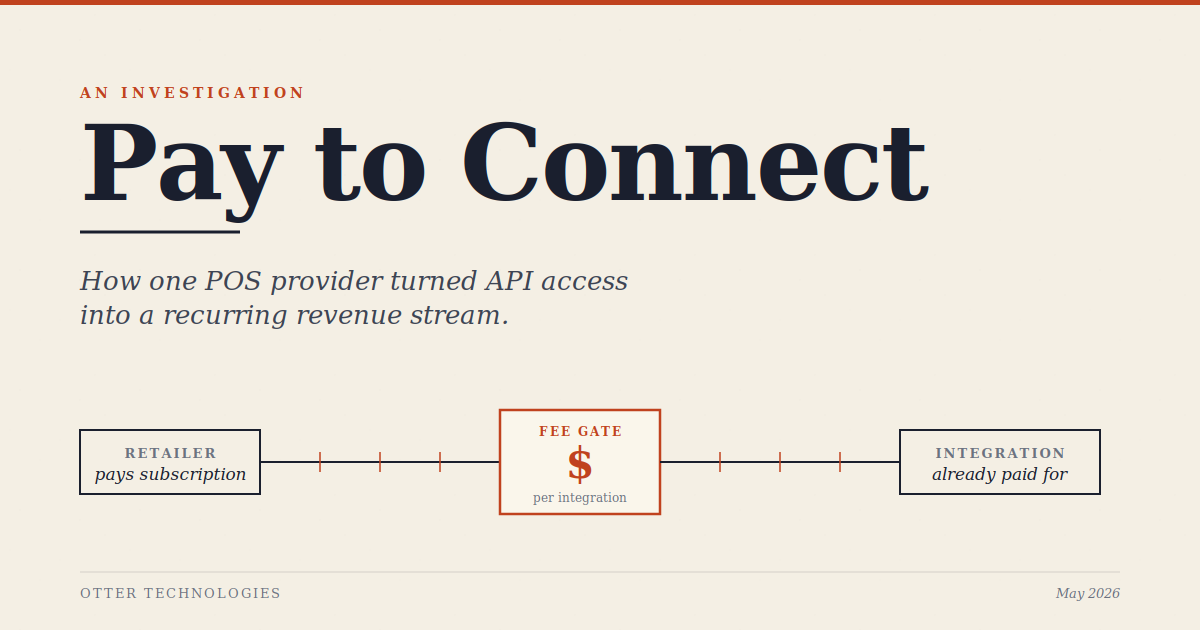
An examination of how integration fees are structured across firearms point-of-sale providers, what retailers should know about vendor compliance in this industry, and how to evaluate a software partner before signing.
Most software providers in the retail space do not charge their customers a separate, recurring monthly fee for the right to use third-party integrations. The thinking is straightforward. A retailer pays for the point-of-sale system. The retailer pays for their digital waiver provider, their CRM, their text marketing platform, their ecommerce connector, and so on. The point-of-sale provider is paid for its own software. Connectivity between systems is treated as part of running a modern stack, not as a separate billable line.
In the firearms retail vertical, one POS provider has taken a different approach. This piece walks through the published evidence, and offers retailers a framework for evaluating their software partners.
December 2025: Across-the-Board Fee Increases
In late 2025, GearFire issued a notice to AXIS retailers regarding upcoming API price changes effective December 1, 2025. The justification offered was inflation, cloud infrastructure costs, and security investment. The new monthly rates GearFire published:
| Billing Name | Impacted Service(s) | Old Rate | New Rate | Change |
|---|---|---|---|---|
| eNICS | e4473 NICS integration | $50 | $100 | +100% |
| eStorage | e4473 Storage | $100 | $200 | +100% |
| OtterCRM | OtterText | $0 | $100 | New charge |
| RangeWorks Core | Memberships, Range, Education | $50 | $100 | +100% |
| RangeWorks eComm | Woo eComm / Guns.com | $50 | $150 | +200% |
| Open eComm | StorePorter, FlxPoint, custom | $50 | $150 | +200% |
A retailer running a common midsize-range stack (NICS, e4473 storage, OtterText, RangeWorks, and an eComm integration) saw their monthly API line jump from roughly $250 to $650. That is an additional $4,800 per year, on top of the AXIS subscription itself.
For context: across-the-board doublings and triplings do not typically reflect underlying infrastructure cost changes. Major cloud providers raise prices, when they do, in single-digit percentages. Cloud storage costs have actually trended down over the past decade. Retailers can draw their own conclusions about the cost basis.
Retailers were offered a narrow window to prepay the year in advance to lock in the previous rate before the increase took effect.
May 2026: An Agreement Declined
In May 2026, Otter Technologies sent GearFire an updated referral agreement intended to reflect the actual commercial relationship between the two companies. The proposed terms preserved a referral commission structure on net new business actually referred by GearFire, while removing entitlement to commissions on existing AXIS retailers who had independently selected OtterText or OtterSign without any referral from GearFire.
GearFire declined to enter into the proposed terms.
May 27, 2026: A Vendor-by-Vendor Pricing Bulletin
On May 27, 2026, GearFire issued a service bulletin to AXIS retailers titled “CRM and Waiver Integration Price Change,” with new pricing taking effect July 1, 2026.
The bulletin lists each integration vendor in the CRM and waiver categories side by side, along with the per-retailer monthly fee and whether the vendor “absorbs the integration fee” or passes it through to the retailer. GearFire’s own published table:
| Vendor | Price | CRM | Waiver | Vendor Absorbs Fee |
|---|---|---|---|---|
| Active Campaign | $0 | ✓ | Yes | |
| Alpine IQ | $0 | ✓ | ✓ | Yes |
| CityGro / Patch | $0 | ✓ | ✓ | Yes |
| Otter Text | $100/mo | ✓ | No | |
| Otter Sign | $50/mo | ✓ | No | |
| ShotPro | $0 | ✓ | Yes | |
| Smartwaiver | $99/yr | ✓ | Partial |
The “Vendor Absorbs Integration Fee” column is GearFire’s own disclosure. It confirms in writing that every integration partner is subject to integration fees, and that those fees are paid either by the vendor (resulting in $0 to the retailer) or passed through to the retailer (resulting in a monthly line item).
OtterText and OtterSign are the only two integrations in the categories listed where retailers see a recurring monthly charge of any meaningful size. Every other vendor in both categories is presented to retailers as free.
How to Vet a Software Partner in the Firearms Industry
Before evaluating any platform, retailers in this industry should ask a specific set of questions about the partners those platforms steer them toward. Not every CRM, SMS provider, or waiver platform on the market is legally permitted to serve firearms businesses, and not every integration partner relationship is structured transparently.
The questions below are a starting point.
Industry Compliance Questions
- Is the vendor explicitly approved for firearms content? Most major SMS and email marketing platforms prohibit firearms-related messaging under their acceptable use policies. Sending a single firearm-related text on an unapproved platform can result in immediate account termination and loss of customer data. Confirm in writing that the vendor allows firearms content, ammunition, accessories, ranges, training, and FFL services.
- Are they SHAFT-compliant for 10DLC messaging? The carrier registration framework for business SMS (10DLC, managed by The Campaign Registry) treats firearms as a regulated category alongside Sex, Hemp/CBD, Alcohol, and Tobacco. A vendor that is not specifically registered and approved for SHAFT campaigns cannot legally send firearms messaging through US carriers, regardless of what their sales team tells you.
- Do they understand ATF-adjacent compliance? A waiver, CRM, or marketing platform serving firearms retailers should at minimum understand TCPA, age-gating, opt-in flow requirements, and the basics of how their tool interacts with regulated firearms transactions. Ask them to describe their last firearms-industry compliance review.
- Do they have firearms-industry customer references? Ask for three current firearms-industry customers, by name, that you can call. A vendor with no real footprint in this vertical is a vendor that has not been tested against the actual operational and regulatory edges of running a firearms business.
Business Conduct Questions
- Does the vendor honor its written agreements? Ask whether the vendor has ever unilaterally raised fees on integrations the customer was already paying for, deleted or rewritten an existing partner agreement, or imposed a new charge on a service the customer had been receiving at no cost. A track record of honoring signed terms is a baseline expectation, not a premium feature.
- Is the fee structure disclosed in full? Confirm that all recurring charges, integration fees, and per-retailer markups are disclosed in writing before signing. A platform that introduces material new fees only after a customer is locked in has different incentives than a platform that prices openly from day one.
- Are integration partners selected by retailers, or by the platform? A POS provider that lets you choose your own CRM, waiver, and marketing tools without surcharge is operating one model. A POS provider that uses fee differentials, preferred-vendor bulletins, or selective billing structures to steer you toward specific partners is operating a different one. Neither is inherently wrong, but retailers should know which model they are buying.
- Are commercial relationships disclosed? When a POS provider recommends a CRM, ask whether the POS provider receives any financial benefit from that recommendation, including direct payments, integration-fee absorption, equity, or revenue share. Retailers are entitled to know whether a “recommendation” is product fit or commercial preference.
These questions apply to every platform serving this industry, including GearFire, AIM POS, Celerant, Coreware, Trident1, Otter Technologies, and any other vendor a retailer is evaluating. The answers are what matter.
A Comparison Worth Making
Retailers evaluating their POS options often ask the reverse question: what do other firearms-industry point-of-sale providers charge to connect to the same third-party tools?
Otter Technologies products (OtterText and OtterSign) integrate with multiple POS providers in the firearms space. Each of those providers has its own approach to integration pricing. Using the same comparison format GearFire chose for its own bulletin:
| POS Provider | Monthly Fee to Connect OtterText | Monthly Fee to Connect OtterSign |
|---|---|---|
| AIM POS (Tri-Tech) | $0 | $0 |
| Celerant | $0 | $0 |
| Coreware | $0 | $0 |
| Trident1 | $0 | $0 |
| GearFire / AXIS | $100/mo | $50/mo |
Every other firearms-industry POS provider that integrates with Otter products charges retailers nothing per month for that connectivity. AXIS is the only one in this comparison that does.
This is not a claim about which POS is better, faster, or more featured. Retailers should evaluate POS systems on the full set of criteria that matter to their operation, including the compliance and business-conduct questions in the previous section. It is simply a published-pricing comparison, presented in the same format AXIS retailers are already familiar with.
What This Means for Retailers
For a retailer using both OtterText and OtterSign on AXIS, the connection fees alone come to $150 per month, or $1,800 per year, paid to GearFire on top of every other line item in their AXIS bill, and entirely separate from what the retailer pays Otter directly for the actual services.
A retailer on any of the other POS systems listed above pays $0 to their POS provider for the same connectivity.
For some retailers, the AXIS platform itself provides enough operational value to justify the integration markup. For others, that math will not work, and the comparison above is a fair starting point for evaluating alternatives.
Where Otter Stands
Our position has not changed.
Otter Technologies will continue to ship the fastest, best-built software in the firearms industry, at the most competitive rates in the market. We built this company to solve real operational problems for firearms retailers, ranges, FFLs, and instructors. We move faster than anyone else in this category, because retailers need software that keeps up with their business, not software that holds it back.
No POS provider can change that by attaching a third-party fee to a retailer’s bill. Retailers who want OtterText and OtterSign will continue to have access to both products. On AXIS, that comes with the fees published above. On AIM POS, Celerant, Coreware, and Trident1, it does not. Retailers can decide for themselves what that comparison is worth.
The information is now public, on both sides of the table.
Pricing referenced in this article is drawn from each provider’s own published rates and from official bulletins issued by GearFire to AXIS retailers in 2025 and 2026. Otter Technologies is the integration partner for OtterText and OtterSign with each of the POS providers listed and can confirm the absence of per-retailer connection fees on the platforms shown at $0. Compliance guidance reflects current Campaign Registry, CTIA, and carrier policies as of mid-2026 and is intended as general retailer education, not legal advice.


